
$325 per person
Mitta Mitta River Gorge Rapid Descent- 1 day
yd7-

Overview
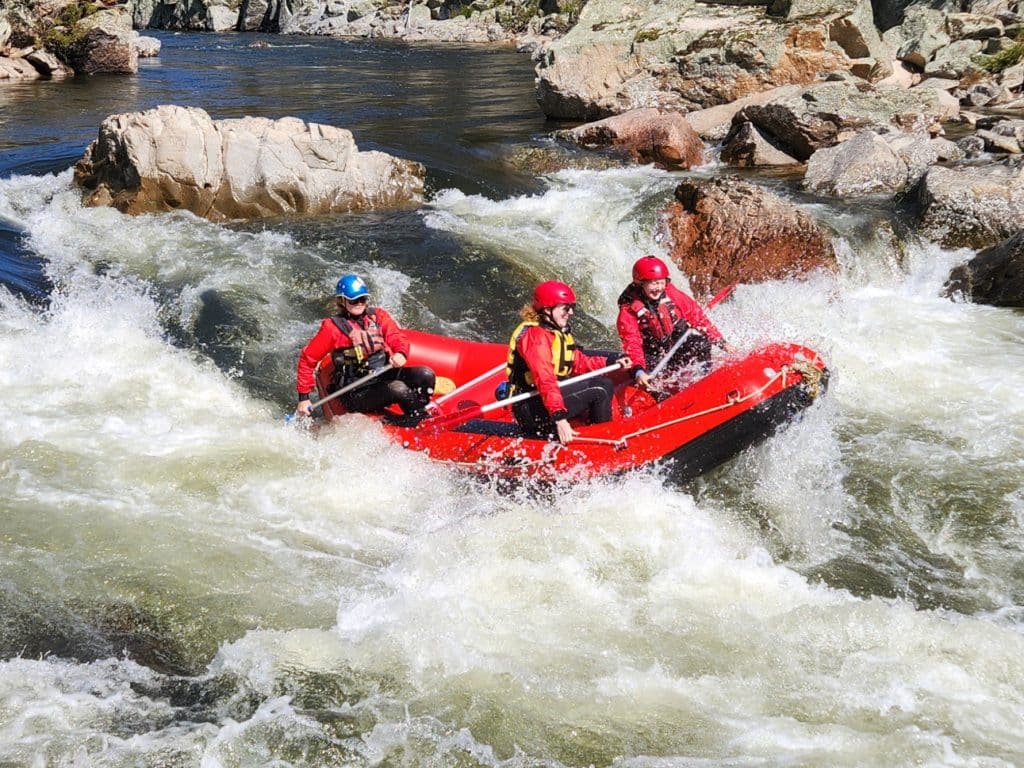
Are you ready to dive into adventure and experience an action-packed alpine river section that starts just a short drive from Omeo township? The classic Mitta Mitta River Gorge Rapid Descent is a great single-day paddling experience designed for those who want a rewarding physical challenge in a stunning, rugged setting. This is without a doubt one of the premier whitewater rafting daytrips in Victoria. Perfect for novices craving excitement and seasoned adventurers alike, it is also just a great day out in nature and a novel way to hang out with friends and family.
Trip Highlights
Key Details
River section is from Bundara Bridge picnic area down to Hinnomumjie Bridge1 dayMinimum 8 guests, maximum 12 guestsSeason July – December (September – October generally highest water)Minimum 16 yrs of age, no maximum ageLunch and snacks providedMeet at Hinnomunjie Bridge 8amRiver section is considered up to Grade 4 but is generally Grade 2/3Important Information / FAQs
Read through this section before booking and refer back to it for answers to frequently asked questions.
What is the itinerary?
Check out the next section for an overview of the itinerary.
What food is provided and what is it like?
Your Mitta Mitta Gorge Rapid Descent day trip includes lunch and snacks. We pride ourselves on providing high-quality, nutritious, and delicious meals wherever we are.
What’s on the Menu?
Lunch & Snacks: Enjoy fresh fruit, homemade slices, high energy snacks and loaded salad rolls to keep your energy high.
Drinks: Tea, Coffee and Hot Chocolate
Dietary Requirements
Our guides can easily cater to a wide range of diverse dietary needs, preferences, and allergies when notified in advance. Please inform us of any special dietary requirements at the time of your booking so we can plan your expedition menu perfectly.
What are the fitness requirements?
The Mitta Mitta Gorge Rapid Descent is a remote, human-powered paddling expedition covering 18km of wilderness river. While the river current provides plenty of momentum, you will still need to paddle consistently throughout the day. There are also critical moments where you must paddle powerfully to navigate the raft safely through turbulent whitewater.
Additionally, you must be physically able to:
Navigate and walk over uneven, slippery surfaces
Climb easily in and out of the watercraft
Maintain a firm grip on safety ropes during rapid descents or potential rescue scenarios [1, 2]
To participate safely, you will need reasonable cardiovascular fitness, a solid baseline of core strength, good upper-body stamina, and excellent balance.
How can I prepare? (Recommended 4–8 Weeks Minimum)
To ensure you can keep your head up to enjoy the spectacular alpine scenery—rather than struggling with intense muscle fatigue—we highly recommend implementing the following training routine:
Cardio Training: Commit to 30–45 minutes of running, cycling, rowing, or swimming 2–3 times per week to build your lung and heart stamina.
Core & Upper Body: Focus on functional strength exercises like planks, push-ups, dumbbell rows, and bodyweight squats to prepare your joints and muscles for thousands of paddle strokes.
Endurance Prep: Training on a rowing machine or a specialized kayak/canoe paddle trainer is highly effective for building the specific back and shoulder endurance required for this trip.
Are there maximum / minimum weight limitations?
YES. For your safety, secure gear fitment, and rescue logistics in remote wilderness environments, we enforce strict weight guidelines:
Maximum Weight Limit: 120kg. This threshold ensures the watercraft maintains optimal stability and guarantees our guiding team can physically execute an in-water rescue if required.
Minimum Weight Limit: 40kg. This baseline is strictly required to ensure that our commercial-grade whitewater lifejackets (PFDs) fit your body securely and will not slip off in moving water.
Equipment Fitment & Safety:
All participants must be able to be securely and comfortably fitted into our standard safety equipment (including lifejackets and helmets) right from the start of the trip. If you are close to these limits or have any concerns about gear sizing, please contact the Group Organiser or call our office directly before booking so we can chat through our equipment specifications!
Do I need to be able to swim prior to the trip?
NO. While swimming ability is obviously desirable, previous swimming skills are not required for this trip and we are fully equipped to accommodate non-swimmers. However, if you cannot swim, you are under a strict obligation to disclose this to us prior to the trip.
Our operation is equipped to accommodate non-swimmers through four key safety measures:
High-Flotation Life Jackets: We provide commercial-grade vests that keep you afloat with your head above water.
Defensive Swimming Technique is taught: If you fall out, you do not swim in a conventional manner. You initially lie on your back with your feet pointing downstream. By using large backstroke arm movements, you can slow yourself down, and by angling your body, you can guide yourself in the direction your head is pointing while the vest floats you.
Milder River Conditions: This trip avoids the risk of swimming in intense Grade 4+ whitewater.
Expert Guide Supervision: Our professional guides are trained in Swiftwater Rescue techniques. They monitor the river constantly and have specialized equipment if required.
Please note: You will be required to declare your swimming ability on your Risk Warning and Waiver of Liability form. Disclosing that you are a weak or non-swimmer will never exclude you from the trip; it simply ensures our guides can provide you with the correct safety briefing and equipment fitment.
Is ambulance cover mandatory?
YES. Having active appropriate ambulance cover is strictly compulsory for all participants.
The Reality of Remote Rescue Costs:
Wilderness rescue is extremely expensive. If you are uninsured, the state governments will bill you the full cost out of pocket:
Road Ambulance: Costs $2,121 in Victoria, or a base fee of $909 plus $8.20 per kilometre in NSW.
Helicopter Rescue: A helicopter extraction from remote terrain incurs a baseline fixed charge of $29,635 in Victoria.
The Simplest Solution for Customers:
To meet this mandatory booking condition quickly and cheaply, we recommend the following options:
1. Ambulance Victoria Membership (Highly Recommended if not covered by below options):
If you are an Australian resident (from any state except QLD/TAS), the easiest fix is to purchase a 1-year Ambulance Victoria Membership online. It costs just $54.97 for a single person or $109.93 for a family. This membership provides 100% free emergency air and land transport within Victoria. (Note: Must be purchased at least 24 hours before the trip).
2. Private Health Insurance:
If you use private health insurance, you must call your provider before the trip. Explicitly verify that your policy includes “comprehensive, nationwide emergency air and land ambulance cover” valid in Victoria.
3. QLD & TAS Residents:
– Automatic Cover: You are automatically covered for emergency ambulance transport by your home state governments while on this trip- ensure you are a current resident.
– Proof of Residency: You must ensure your principal place of residence is legally registered in Queensland or Tasmania. Bring your state residency proof, such as a valid driver’s licence.
– If You Receive a Bill: If you are treated or transported by a Victorian ambulance crew, an invoice may be mailed to you. Do not pay it out of pocket. Simply forward the physical invoice along with a copy of your driver’s licence to your home state’s ambulance service (Queensland Ambulance Service or Ambulance Tasmania) to have the fee settled.
Important Enforcement Notice: You must provide your ambulance membership number or private health fund details prior to departure. Failure to provide proof of valid ambulance cover will result in a refusal of entry onto the trip with no refund provided.
NOTE: Any costs mentioned in this section are correct at time of writing.
Is travel insurance mandatory?
NO. Travel insurance is not required to join this tour. However, it may be considered to protect your financial investment. If an unforeseen emergency, sudden illness, or vehicular breakdown forces you to cancel your trip at the last minute, a comprehensive domestic travel insurance policy is the only way to recover your non-refundable booking fees.
Because standard, off-the-shelf domestic policies usually only cover up to Grade 3 whitewater, you must secure a policy that explicitly covers Grade 4 whitewater rafting. Your policy must be purchased and active from the date your deposit is paid for your cancellation coverage to be valid.
Important Grade 4 Rapid & Portage Policy
The section of the Mitta Mitta River Gorge we navigate contains rapids officially rated up to Grade 4. Even if water levels fluctuate and our guides evaluate certain rapids differently on the day, or physically walk you around larger rapids for safety, insurers assess risk based on the official classification of the entire river segment. Because you cannot rely on standard Grade 3 coverage, you must treat this as a Grade 4 trip when selecting your policy.
Common market options utilized by adventure travelers include:
Fast Cover: Their Comprehensive or Standard Saver domestic plans allow you to add an optional “Adventure Pack” at checkout, which explicitly extends coverage to recreational Grade 4 and 5 rafting.
Cover-More: Their domestic policies allow you to upgrade your plan with an optional “Adventure Activities” extra.
1Cover: Their standard domestic plans offer an optional “Adventure & Sports Pack” rider.
Note on Cost: Adding these sports packs usually adds an estimated premium cost of $15 to $35 on top of a basic domestic policy.
CRITICAL: Why separate Ambulance Cover is STILL mandatory
Many travelers incorrectly assume that travel insurance handles emergency medical transport. Domestic travel insurance policies do NOT pay for emergency road ambulances or helicopter rescues within Australia.
Because the Mitta Mitta River Gorge is remote, an extraction requires specialized emergency services. If you are uninsured, the government will bill you directly. According to the Victoria Department of Health, a regional emergency road ambulance in Victoria costs $2,121, and a helicopter extraction base charge starts at $29,635.
Therefore, maintaining a valid Ambulance Victoria membership (or holding a private health insurance policy that explicitly guarantees emergency transport across state borders) is strictly compulsory for this trip.
Important Legal & Medical Expense Notice
By Australian law, domestic travel insurance cannot cover medical, hospital, or surgical expenses incurred within Australia. Domestic insurers operate under the assumption that Medicare, your private health insurance, or a valid ambulance membership will absorb those direct treatment costs.
Consequently, travel insurance is purely designed to protect your financial costs against unforeseen disruptions (such as us canceling the departure due to dangerous high water levels, floods, or extreme weather). It will recover non-refundable trip fees, cancellation costs, and lost luggage, but it cannot be used to pay for injuries or medical treatment.
Financial Advice Disclaimer
Our company is an adventure tourism operator and does not hold an Australian Financial Services Licence (AFSL). The insurance information provided above is purely factual information regarding options available in the Australian marketplace. It does not constitute personal financial product advice, a recommendation, or an endorsement of any specific provider. You must read the relevant insurer’s Product Disclosure Statement (PDS) and Target Market Determination (TMD) to ensure the policy meets your individual circumstances before purchasing.
NOTE: Any third-party costs mentioned in this section are correct at the time of writing and are subject to change by their respective providers.
Is Private Health Insurance mandatory?
NO. However, it may be beneficial. While Medicare covers public hospital emergencies, private health insurance closes critical gaps that standard travel insurance does not, such as covering out-of-hospital expenses like follow-up physiotherapy or rehabilitation.
Using Private Health to Meet Your Mandatory Ambulance Requirement:
Many comprehensive or top-tier private health policies bundle true, nationwide ambulance coverage. If your private health policy explicitly includes emergency air, land, and helicopter transport valid in Victoria, it will completely satisfy our mandatory ambulance cover condition.
Before relying on this option, you confirm that your private health fund will absorb the full cost of remote wilderness rescues (that may include helicopter extraction. If your private health policy only covers basic road transport or restricts coverage to your home state, it does not meet our requirements, and you must purchase a standalone Ambulance Victoria Membership instead.
What is included?
On-tour transport: Transport from Hinnomunjie Bridge to the put in point at the Bundara Bridge picnic area.
Meals: Lunch and Snacks inc. tea, coffee and hot chocolate.
Drinking water: Drink water brought.
Apparel: Wetsuit, neoprene socks, paddling thermal top, and paddling spray top.
Water gear: Boats and all necessary paddling equipment.
Itinerary: All trip activities explicitly outlined in the schedule.
Staff: Experienced guides with specific knowledge of the river.
Safety gear: River rescue equipment, group first aid equipment, and satellite communication systems.
Hygiene: Toilet system, handwash system.
Storage: Dry bags for some personal gear such as spare clothes.
What is not included?
Non-Tour Transport
Travel to meeting point: Transportation to Hinnomunjie Bridge.
Insurance & Cover
Travel insurance: Suggested for unforeseen non-attendance.
Ambulance cover: Compulsory to have, but not paid for by the tour.
Personal Items
Clothing: All personal clothing.
Medication: All personal medication.
Other: Water bottles.
What should I bring?
Required equipment:
– Water bottle- at least 1L
– Comfortable change of clothes & shoes for after paddle (these could be the same clothes you travel in as you change before going to the put in)
– Towel
– 1 rainproof jacket with hood
– 1 jumper
– Set of long thermal underwear (if conditions are cold or if you get cold easily)
– Sunhat
– Sunscreen and lip balm
– Strap for glasses if worn
– Joggers (or secure water-specific shoes, not slip-on style) which can be worn in the boat and walking around the edge of the river
– Any personal medication
Optional:
– Sunglasses
Can I bring my own alcohol?
NO. You cannot bring alcohol on this trip.
Alcohol Restrictions & Rules
Daytime / On the water: You must maintain a 0.0% Blood Alcohol Concentration (BAC). Absolutely no drinking is allowed while paddling or during daytime activities.
Safety & Duty of Care Responsibilities
Guide responsibility: The tour operators have a legal duty of care to keep you safe both on and off the water.
What are the booking and cancellation policies?
Our Mitta Mitta Gorge Rapid Descent requires a minimum of 8 participants and a maximum of 16. For group bookings, the payment schedule is locked into a baseline of 8 people to secure the trip, with adjustments made on Day 1 for any additional guests:
At Booking: A 100% non-refundable deposit based on the 8-person minimum is due immediately to lock in your tour dates.
Day 1 of the Trip (Additional Guests): If your group expands beyond the initial 8 people (up to our maximum of 16), the full 100% per-person payment for those additional participants is due immediately on the first day of the trip before departure.
Travel Insurance: Because all payments are non-refundable once paid to cover locked-in tour logistics, group members may wish to purchase comprehensive travel insurance covering Grade 2 whitewater rafting trips from the day their deposit is made. This is a way to recover non-refundable booking fees if you have an unforeseen emergency, sudden illness, or car breakdown forces you to cancel at the last minute
IF THE CUSTOMER CANCELS
Because our milestone payments are explicitly non-refundable once paid to secure locked-in permits, guides, and catering, any cancellation by the customer will result in a forfeit of all funds paid up to that date. Guests must claim these non-refundable booking costs back through their domestic travel insurance provider, if they have an applicable policy.
IF WE CANCEL THE TRIP
As professional wilderness operators, safety is our absolute priority. Cancellations are handled under the following strict legal and operational guidelines:
Force Majeure / Unsafe High Water Levels- The Service is Impossible (Frustrated Contract):
If extreme, widespread regional weather patterns meanthe Snowy River cannot be safely navigated, the contract is legally considered “frustrated” due to a natural disaster outside of everyone’s control. In this scenario: Wieland Adventures will issue a refund of your booking fees minus any unrecoverable operational costs that our business has already physically disbursed and cannot claw back (such as pre-purchased expedition catering, paid guide wages, non-refundable bus hire costs, etc.).
We will provide you with an official Cancellation Certificate detailing the exact environmental cause and retained costs so you can claim 100% of your out-of-pocket losses back through any travel insurance you may have.
Alternatively, you can choose to bypass the insurance process entirely and roll 100% of your total booking value into a Future Trip Credit (valid for 24 months), and we will apply a bonus 10% value voucher to your account as a thank-you.
Internal Operational Cancellations (Non-Environmental):
In the rare event that Wieland Adventures must cancel a trip due to internal logistical or operational disruptions (such as sudden vehicle breakdown, unexpected guide injury/illness, or failure to meet minimum operational safety requirements):
– You will receive a 100% full cash refund of all money paid to us (the initial deposit).
– Please note that our liability remains strictly limited to the return of your tour package price. We accept no liability or responsibility for your personal travel costs, non-refundable flights, rental cars, or external hotel bookings, which must be managed via your travel insurer, if you have one.
How do I book?
Booking your expedition with Wieland Adventures is a simple manual process managed directly via phone and email to ensure your group gets personalized staging and date holds:
1. Check Availability: Call or email our office to check calendar availability. We will place a temporary 48-hour hold on your requested dates.
2. Mandatory Group Review: We will email the Group Organiser a 1-page Pre-Deposit Safety & Policy Agreement along with our FAQ link. The Group Organiser must immediately forward the FAQ link to all group members. Every participant must read and agree to the safety FAQs and cross-border ambulance rules BEFORE the next step can occur.
3. The Pre-Deposit Agreement: Once every participant has read the FAQs and confirmed their compliance to the Group Organiser, the Organiser signs the Pre-Deposit Safety & Policy Agreement on behalf of the group and emails or texts a photo of it back to us.
4. The Invoice & Payment: Once we receive the signed agreement, we will email you an official invoice for the 100% non-refundable deposit based on our minimum participant numbers. Transfer the 100% deposit via bank transfer to officially lock your dates into our master calendar.
5. The Waiver & Details Package
Once the deposit payment clears, we will email the master Risk Warning and Waiver of Liability form directly to the Group Organizer to begin collecting individual ambulance cover details. You will also receive a Participant Details Form to gather next-of-kin contacts, medical histories, and specific dietary requirements.
Do I need to sign a waiver form?
YES. Because our trips journey into remote environments, rugged terrains, and whitewater rapids, every participant must fill out and sign our formal Risk Warning and Waiver of Liability form before their trip begins.
Why we require this:
-Safety & Accountability: Remote outdoor trips carry inherent outdoor risks, both on and off the river. The waiver ensures that every guest understands the nature of a remote expedition and agrees to follow all safety directions given by our expert guides right from the start of the trip.
-Financial Protection (Your Ambulance Cover Check): Unpredictable weather, rugged terrain, and wild river systems mean accidents can happen, and remote rescues are exceptionally expensive. We use the waiver to legally verify that you have written down your mandatory valid ambulance membership (valid in Victoria). This ensures that if you are injured, you are fully insulated against massive out-of-pocket rescue losses.
How it works for Group Bookings:
If you are booking for a group of friends, our system enforces a strict process to ensure every single person has full prior notice of our safety standards before any financial commitment is made:
1. The Pre-Deposit Requirement: The Group Organiser is legally barred from signing our booking forms or paying a deposit until every participant has read, understood, and agreed to our website FAQs. By authorizing the Group Organiser to sign, the entire friend group is agreeing to our Day 1 high-water cancellation and refund policies.
2. Filling Out the Master Waiver: Once the deposit is paid, the Group Organiser will distribute the individual Risk Warning and Waiver of Liability forms. Every group member must physically write down their cross-border ambulance membership details, and sign their form.
3. Final Return: The Group Organiser collects and emails all signed individual waivers back to us prior to the trip departure date. Note: By signing their individual waiver, each participant legally re-verifies that they have read and agreed to our website FAQs.
4. Day 1 Enforcement: Failure to provide valid ambulance details on your signed waiver prior to departure will result in an immediate refusal of entry onto the trip with no refund provided.
What are the trip meeting details?
Meet at the Hinnomunjie Bridge Picnic Area (NOT the Hinnomunjie township, lookout or connection road and also NOT the Bundara Bridge Picnic Area) on the day of the trip no later than 8:30am. We meet here so that you can paddle straight back to you cars, dry clothes, toilets and change areas.
What do we do for toilets on the trip?
There are drop toilets at the Hinnomunjie Bridge Picnic Area and the Bundar Bridge Picnic Area.
If you needed to go while on the river we have provision for that using WAG Bags.
What are WAG Bags?
Because we travel through fragile alpine ecosystems where burying waste is ecologically damaging, we use a modern, sterile system called a WAG Bag (Waste Alleviation and Gelling bag).
Each lightweight, commercially manufactured kit is an individual, double-bag system containing a NASA-developed, odor-neutralizing gelling powder, toilet paper, and an airtight, puncture-resistant zip seal. It is completely hygienic, leaves zero mess, and ensures we protect the areas we travel thtough by completely packing out all human solid waste. You will be provided with your own WAG Bags and instruction on the hike.
Urine:
Avoid urinating in your WAG Bags. Instead, you can urinate directly on the ground anywhere private that is more than 50 meters away from the river or any other waterway. If you use toilet paper, do not leave it on the ground or bury it. Place your used paper into a WAG Bag..
Sanitary & Hygiene Products
Sanitary products must never be left on the ground or buried.
Sanitary products may be put straight into your personal WAG Bag.
What systems are in place for outside communication on the trip?
Mobile Coverage and Wi-Fi
– Hinnomunjie Bridge Picnic Ground: There is weak mobile reception at this location- we will generally receive texts, at the very least, when we are waiting here.
– Omeo: Good mobile coverage
– On the road to the river and on the river: Little mobile coverage and it should not be relied upon
UHF Radio Repeater Coverage
There is a UHF repeater located on the summit of Mt. Ned (just above the Anglers Rest Campground). It operates on Channel 2 and it activated by having a unit on the correct channel and set to Duplex/Repeater mode. Guides will carry UHF radios for outside and emergency communication if necessary.
Satellite Communications on the River
We carry at least two Zoleo satellite communication devices on the river. These are used primarily to receive river level updates, track weather forecasts, and maintain emergency communication with our base contacts. They also feature a dedicated SOS distress button. Unlike older systems, this is a two-way emergency system; if triggered, it sends our exact GPS location to search and rescue services, allowing us to text back and forth with emergency operators until help arrives.
Leaving a Contact Number
Please ask for our off-river contact details prior or on Day 1 of the trip. If family or work contacts need to get an urgent message to you while you are on the river, they can call our off-river contact person directly. Our off-river contact will evaluate the message and arrange communication with our river group via the Zoleo units.
Book your Rapid Descent with Wieland Adventures today!
Itinerary
While this itinerary outlines our intended journey, the final daily schedule is subject to adjustment based on river conditions, weather patterns, group safety requirements and other possible factors.
MITTa mitta river gorge rapid descent
Your adventure begins
8:30 AM Meeting: Meet your professional guides and fellow travelers at the Hinnomunjie Bridge parking area.
Parking: Vehicle storage is arranged here at the river take-out point for the day.
Expedition Briefing: Receive a briefing on the legendary 18km gorge section ahead, river conditions, and the safety plan for the day.
Gear Fitting: Get fitted up with your high-quality safety gear, including wetsuits, thermal layers, helmets, and personal flotation devices (PFDs).
Transit to the River: Board the group transport vehicle for the journey up the valley to the launch site near the Bundarra River confluence.
Safety Briefing: Complete a comprehensive dry-land paddle presentation and swiftwater safety briefing before launching the rafts into the crystal-clear alpine water.
Crew Drills: Practice paddling as a team and getting to know responses to guide commands.
Negotiate the Rapids: Work together with your crew to navigate the river, conquering well known rapids such as Graveyard, Big Stopper, Dislocation, S-Bend, The Waterfall, andThe Gobbler (having snacks and a hearty lunch along the way)
Back to the start: Paddle under the Hinnomunjie Bridge back to your cars.
4:30 PM Back at the Cars: Enjoy a hot drink and a laugh before departing.
Book Your Adventure